
Parent Categories

Related blogs


Related Products


Related Books

Walt Whitman, Dead Poets Society & the Poem That Made a Generation Stand on Their Desks
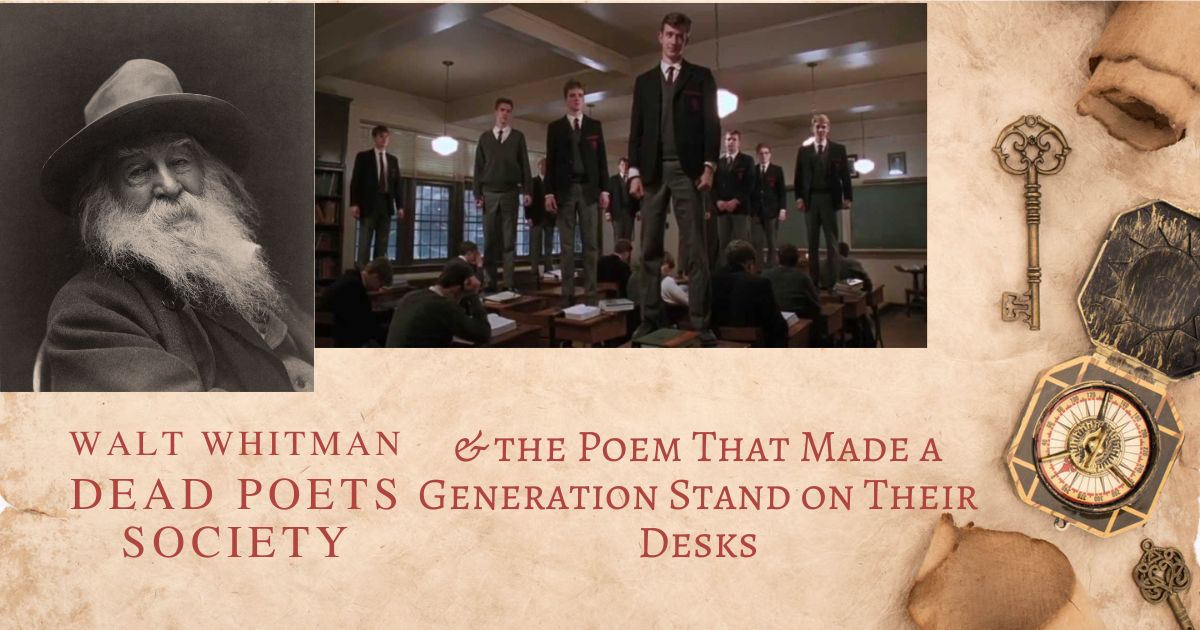 Walt Whitman, Dead Poets Society
There are very few moments in cinema where literature stops feeling like homework and suddenly becomes something alive. For an entire generation, that moment arrived when a group of schoolboys climbed onto their desks and whispered, then declared, ‘O Captain! My Captain!’
And just like that, thousands of teenagers across the world met Walt Whitman without ever opening a poetry anthology first.
They met him through Dead Poets Society.
The film did not merely revive a nineteenth-century poem. It transformed it into a cultural ritual. Even today, decades after the film’s release, the image remains unforgettable: boys standing tall on wooden desks, defying authority, honouring the teacher who taught them to think for themselves. At the centre of that scene stood Robin Williams as John Keating—warm-eyed, wounded, mischievous, and fiercely devoted to poetry.
But the story of that moment begins long before the classrooms of Welton Academy. It begins in 1865, with grief.
Also read: 8 Classic Novels That Became the Movies & Shows Everyone's Talking About
The Poem Born from a National Tragedy
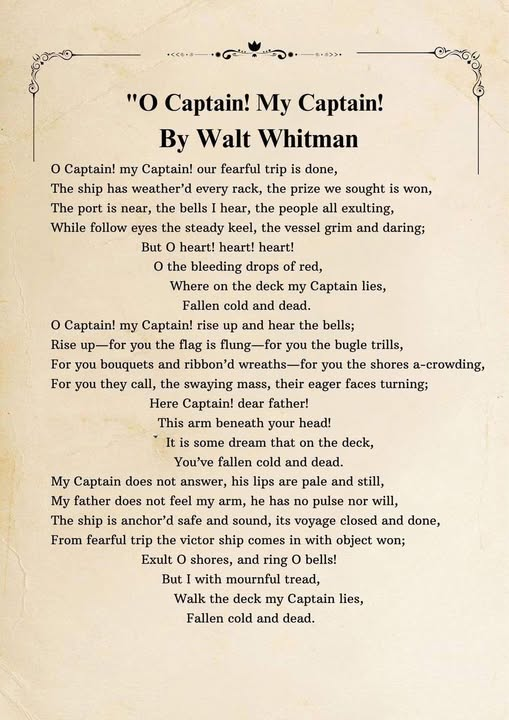
Whitman wrote ‘O Captain! My Captain!’ after the assassination of Abraham Lincoln. America had just emerged from the devastation of the Civil War. The ‘fearful trip’ mentioned in the poem was the war itself, and the captain was Lincoln—the leader who had guided the nation through its darkest waters, only to fall before reaching the shore safely.
What makes the poem remarkable is how restrained it is. Whitman was famous for expansive free verse and sprawling poetic rhythms, especially in ‘Leaves of Grass’. But ‘O Captain! My Captain!’ is unusually controlled—rhymed, structured, almost musical. Critics have often pointed out that it is one of the least ‘Whitman-like’ poems he ever wrote, yet it became the most famous during his lifetime.
Perhaps grief demanded simplicity.
Perhaps sorrow always does.
For generations, the poem existed primarily as a historical elegy. Students memorised it. Teachers explained the ship metaphor. Exams asked what the captain symbolised. It remained respected, but distant.
Then came 1989.
When Dead Poets Society Brought Whitman Back to Life
In Dead Poets Society, John Keating walks into a classroom full of boys trained to obey rules and inherit expectations. Welton Academy values discipline, conformity, and prestige. Keating values wonder. He asks his students to rip pages from textbooks, stand on desks to change perspective, and remember that poetry is not a luxury but a necessity.
‘We don’t read and write poetry because it’s cute,’ he says. ‘We read and write poetry because we are members of the human race.’
And suddenly, poetry is no longer dusty.
It breathes.
Keating invites his students to address him as ‘Captain’, inspired by Whitman’s poem ‘O Captain! My Captain!’—a gesture that later becomes heartbreakingly meaningful. The phrase has since escaped the boundaries of both classroom and cinema, finding its way onto bookmarks, wall art, and literary keepsakes—including a beautifully designed ‘O Captain! My Captain!’ poster available here.

What begins as an affectionate literary reference becomes devastatingly meaningful by the film’s ending, when Keating is dismissed from the school and the students, one by one, rise onto their desks in silent rebellion.
‘O Captain! My Captain!’
It is impossible to watch that scene without feeling something tighten in your chest.
Because the moment is not really about a teacher.
It is about the people who change us quietly.
The adults who tell us that our voice matters.
The books that arrive at exactly the right age.
The dangerous thrill of discovering that life can be larger, stranger, and more beautiful than the world has prepared you for.
The Generation That Discovered Poetry Through Cinema
For many viewers, especially teenagers, the film became their first emotional encounter with poetry. Not analysis. Not interpretation. Emotion.
And Whitman was at the centre of it.
Ironically, many people who can quote ‘O Captain! My Captain!’ today have never read Whitman beyond those lines. Yet that is also part of poetry’s strange magic. A poem can outgrow its original context. Whitman wrote about Lincoln, but the words have been reused repeatedly for figures people mourn and admire.
After Robin Williams died in 2014, countless tributes recreated the desk-standing scene from the film. Once again, audiences whispered, ‘O Captain! My Captain!’—this time for the actor himself.
The poem had completed another voyage.
Whitman and Keating: Believing in Individuality
What makes this enduring connection between Whitman and Dead Poets Society so fascinating is that both believe in the same thing: individuality.
Whitman’s poetry celebrated the self long before modern culture embraced self-expression. He wrote about bodies, souls, labourers, wanderers, lovers, and dreamers with astonishing openness. He believed ordinary lives deserved grandeur.
Keating teaches the same lesson in a different century.
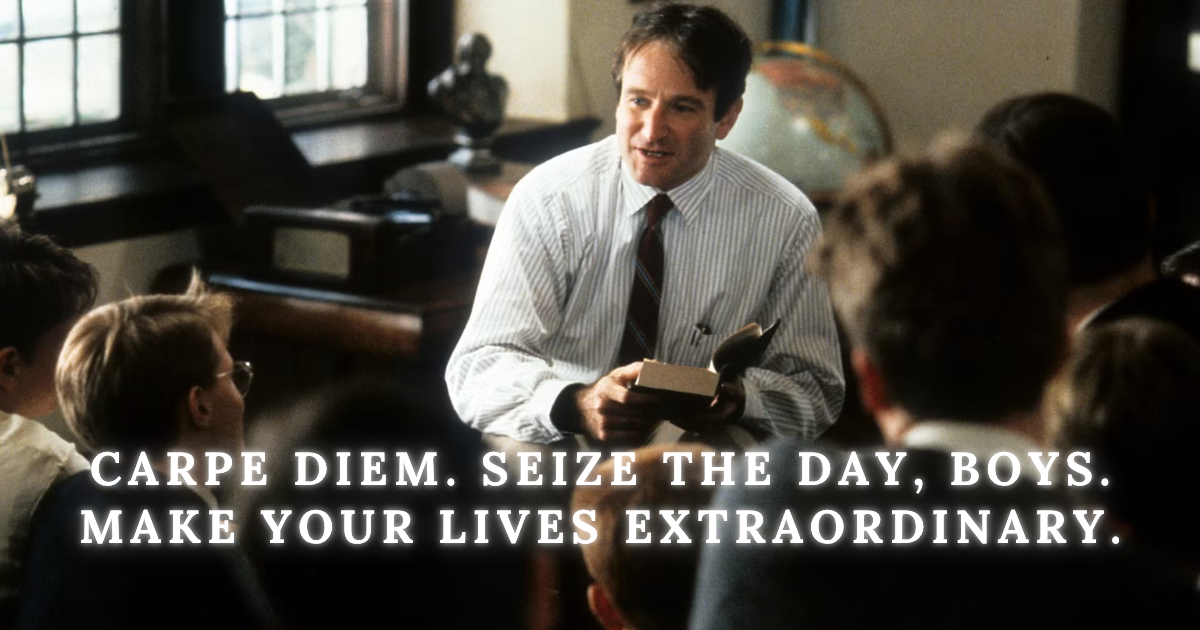
‘Carpe diem,’ he tells the boys. Seize the day.
Not because life is easy, but because it is fleeting.
That idea struck an especially deep chord with young audiences. Adolescence is often defined by invisible pressure—to succeed, conform, behave correctly, choose the right future. Dead Poets Society offered another possibility: what if passion mattered too? What if poetry, art, music, and reckless imagination were not distractions from life, but the very things that made life meaningful?
Why the Desk-Standing Scene Still Endures
That is why the desk-standing scene survives in popular culture. It is not nostalgia alone. It is recognition.
Almost everyone remembers a moment when they first encountered art that made them feel seen.
For some, it was a song.
For others, a novel.
For many, astonishingly, it was an old poem by Walt Whitman echoing through a classroom in Dead Poets Society.
A nineteenth-century elegy became a twentieth-century cinematic rebellion and then a timeless symbol of gratitude, grief, and awakening.
Not bad for a poem once trapped inside textbooks.
Your next read: Elementary, Dear Reader: 7 Things You Never Knew About Arthur Conan Doyle