

Parent Categories

Related blogs


Related Products




7 T. S. Eliot Poems Every Literature Lover Should Read
 T S Eliot
Few poets have captured the strange, restless mood of modern life quite like T. S. Eliot. His poems can feel fragmented, mysterious and even intimidating at first, filled with voices, quotations, literary references and sudden shifts in time and place. Yet beneath that complexity is a poet deeply interested in questions that remain remarkably familiar: What gives life meaning? Why do people feel lonely in crowded cities? Can faith survive doubt? And what does it mean to live in a world that seems to have lost its certainty?
Born in St. Louis in 1888 and later settled in Britain, Eliot became one of the defining literary figures of the twentieth century. His poetry helped reshape modernism, breaking away from the expectations of traditional poetic form and creating a new language for a fractured age.
If you are beginning your journey into Eliot, these seven poems offer a fascinating way in.
Also read: One Stormy Night, One Ghost Story Contest: How Mary Shelley's Frankenstein Was Born
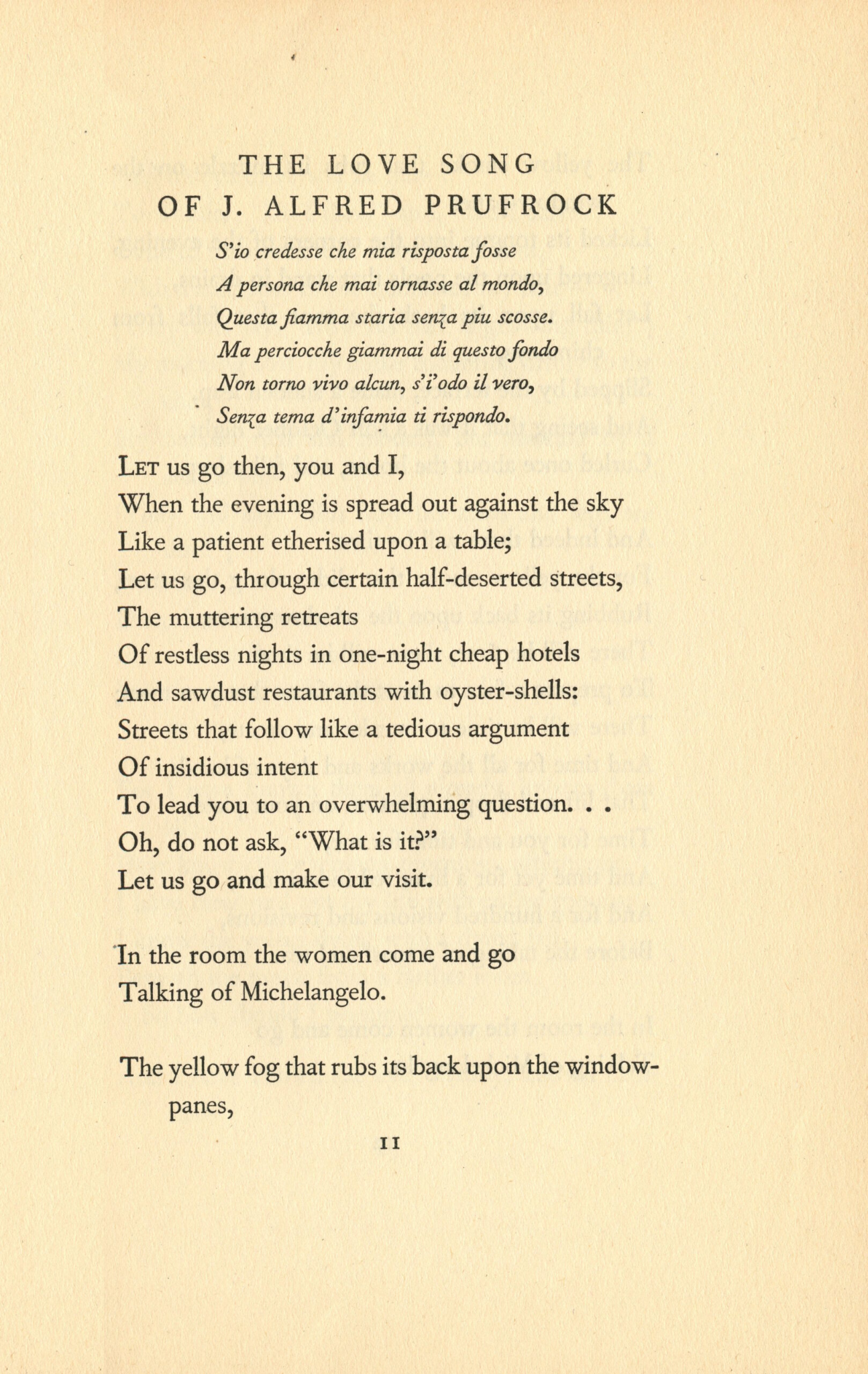
1. ‘The Love Song of J. Alfred Prufrock’
 [Image credit: www.donyorty.com]
Start with the man who famously asks, “Do I dare?” ‘The Love Song of J. Alfred Prufrock’ is perhaps Eliot's most accessible introduction to his poetic world.
Published in 1915, the poem follows Prufrock, an anxious, self-conscious man wandering through an urban landscape while contemplating conversation, love, ageing and his own inadequacies. There is no grand romantic declaration here. Instead, Eliot gives us hesitation, overthinking and the fear of being judged.
That is precisely what makes Prufrock feel so modern. His worries about appearance, social interaction and whether he has lived enough are not confined to the early twentieth century. The poem turns ordinary insecurity into something almost existential.
Its famous images—from the evening compared to a patient on an operating table to Prufrock measuring out his life in coffee spoons—show Eliot's extraordinary ability to make the familiar unsettling.
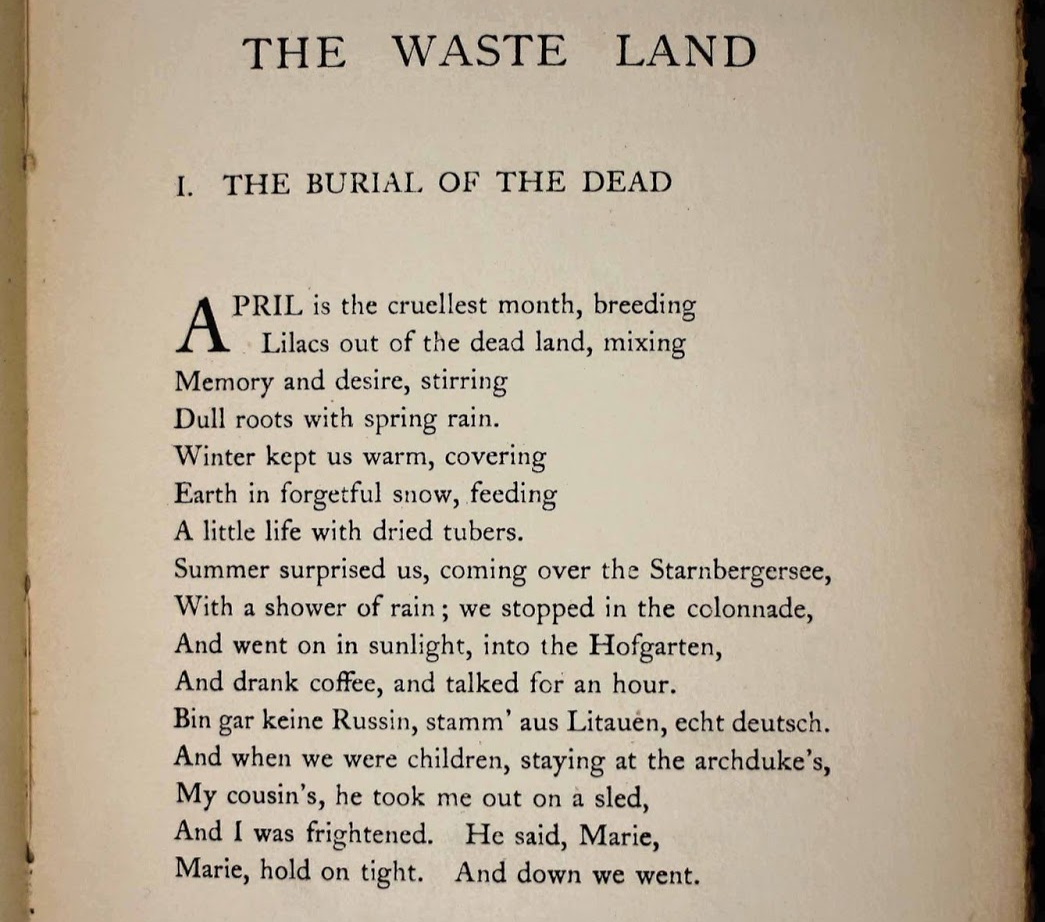
2. ‘The Waste Land’
 [Image credit: www.thearticle.com]
If Prufrock introduces Eliot's anxious modern individual, ‘The Waste Land’ introduces the broken world around him.
Published in 1922, this monumental poem is one of the central works of literary modernism. It moves through different speakers, cultures, myths and literary traditions, creating a deliberately fragmented portrait of civilisation after the trauma of the First World War.
At first, the poem can seem like a maze. But that fragmentation is part of its meaning. Eliot's world is filled with people who are spiritually exhausted, disconnected from one another and searching for something that might restore meaning.
The poem's complexity rewards repeated reading. You do not need to understand every reference to appreciate its atmosphere. Read it once for the mood, again for the images and then return to it to discover how its many voices begin speaking to one another.
Buy here: The Waste Land (with Prufrock, The Hollow Men, and Other Poems)
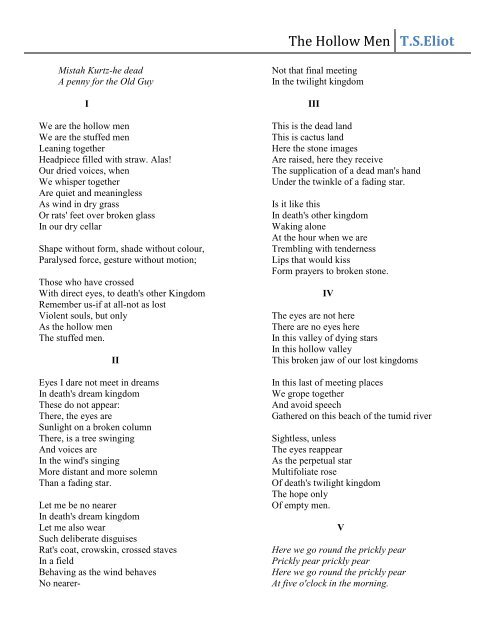
3. ‘The Hollow Men’
 [Image credit: www.yumpu.com]
“Between the idea / And the reality” lies one of the central tensions of ‘The Hollow Men’.
Published in 1925, the poem explores spiritual emptiness and paralysis. Its speakers are neither heroic nor dramatically evil. They are hollow—people who seem unable to turn thought into action or desire into meaningful change.
The poem's haunting atmosphere comes from this sense of absence. There is plenty of language, but little certainty; plenty of thought, but little action.
Its ending is among the most recognisable passages in twentieth-century poetry, transforming the idea of apocalypse into something strangely anticlimactic. Eliot suggests that civilisation may not collapse with a spectacular bang. Sometimes, it simply loses the ability to act.
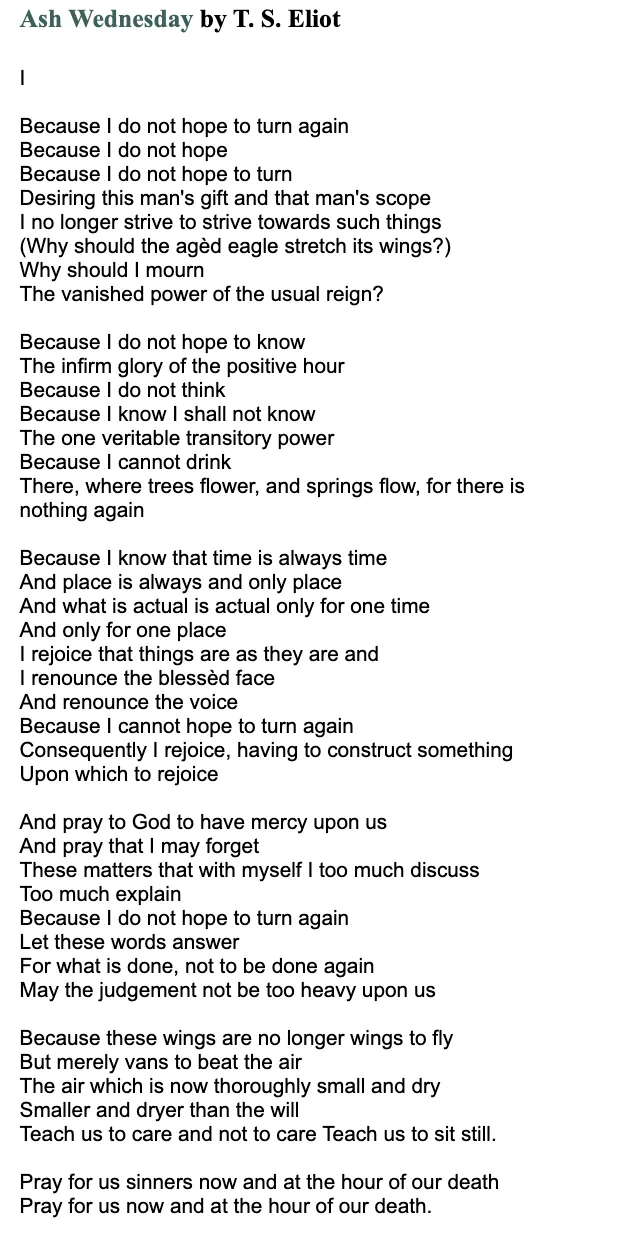
4. ‘Ash-Wednesday’
 [Image credit: www.reddit.com/r/Poetry/comments/15zg697/poem_ash_wednesday_ts_eliot/]
With ‘Ash-Wednesday’, Eliot's poetry turns more explicitly towards spirituality.
Published in 1930, the poem reflects the struggle between doubt, desire and the search for religious faith. It is not a straightforward declaration of certainty. Instead, it feels like a difficult journey towards belief, filled with hesitation and self-questioning.
This makes Ash-Wednesday particularly interesting for readers who have encountered Eliot primarily as the poet of modern alienation. Here, the spiritual world does not magically erase uncertainty. Faith itself becomes a process of confronting it.
The poem is quieter and more meditative than The Waste Land, making it an important step into Eliot's later work.
5. ‘Journey of the Magi’
 [Image credit: https://x.com/DemocritusSr/status/2003671239710376076]
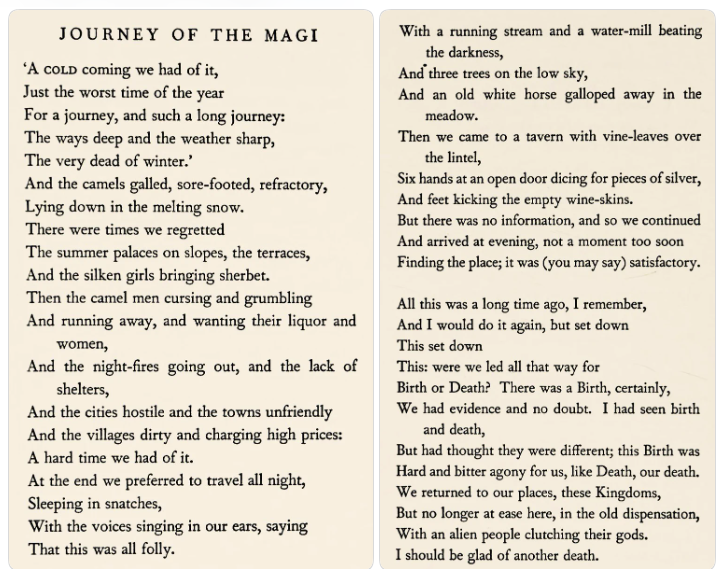
A short poem with a surprisingly large emotional landscape, ‘Journey of the Magi’ retells the Biblical journey of the Wise Men travelling to witness Christ's birth.
But Eliot's Magi are not simply celebrating a miraculous event. The journey leaves them changed. Having witnessed a birth, they also feel that they have experienced a kind of death—the death of the world and identity they knew before.
That tension between birth and death is quintessentially Eliot. Transformation, the poem suggests, is rarely comfortable. To discover something new may require leaving an old self behind.
6. ‘Burnt Norton’
 [Image credit: www.poemhunter.com]
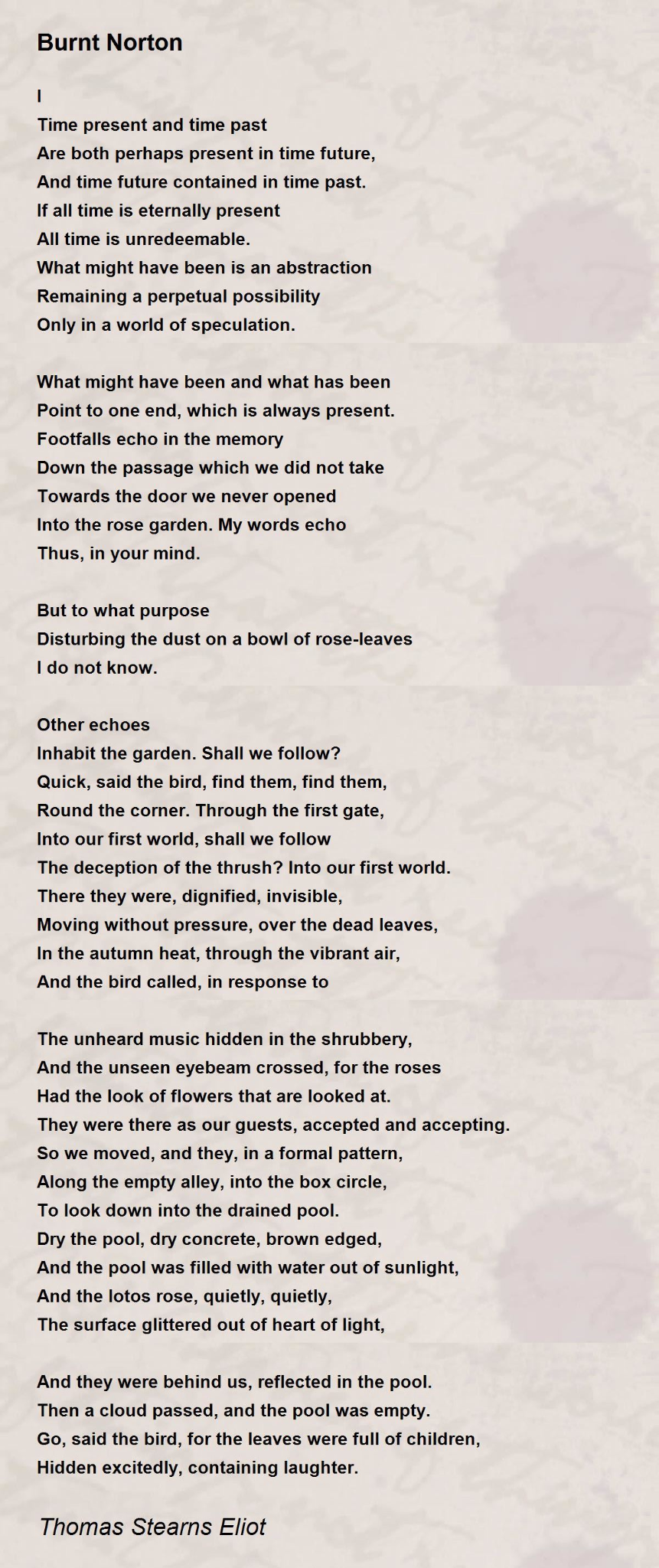
“Time present and time past” opens ‘Burnt Norton’, the first of the four poems eventually collected as Four Quartets.
Written in the late 1930s, it is one of Eliot's great meditations on time, memory, possibility and spiritual awareness. The poem repeatedly asks us to think about moments that might have happened, moments that did happen and moments that exist only as possibilities.
Unlike the frantic fragmentation of his earlier poetry, Burnt Norton is contemplative. Its language encourages the reader to slow down and consider the relationship between past, present and future.
It is especially rewarding for anyone fascinated by the philosophical side of poetry.
7. ‘The Dry Salvages’
 [Image credit: www.scribd.com]
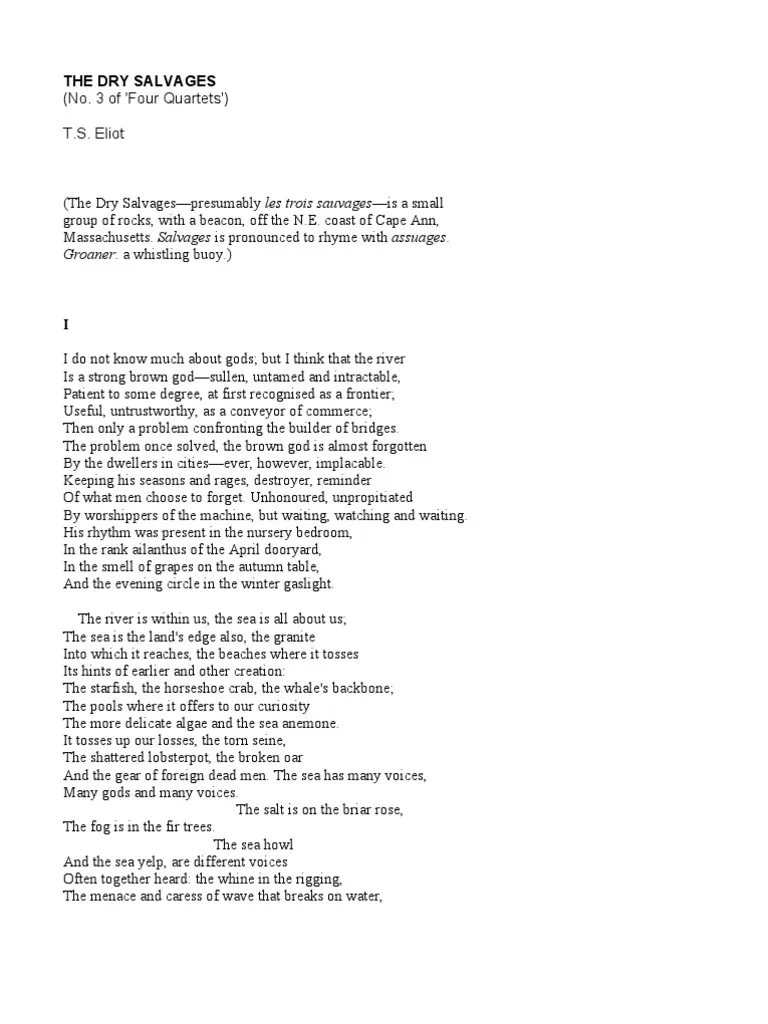
The third poem in Four Quartets, ‘The Dry Salvages’, takes its title from a group of rocks off the coast of Massachusetts, near Eliot's birthplace.
Here, water becomes a powerful symbol for time and human existence. Rivers, oceans, journeys and tides allow Eliot to explore memory, mortality and the human desire to control a future that cannot be controlled.
The poem also brings together personal memory, history and religious thought. Like much of Eliot's later poetry, it asks readers to look beyond the immediate moment and consider the larger patterns of existence.
Why Eliot Still Matters
Reading Eliot can feel like entering a conversation that began before you arrived. His poems borrow from mythology, religion, Shakespeare, Dante and other writers while simultaneously responding to the anxieties of his own century.
That is perhaps why they remain so compelling. Eliot wrote about a world experiencing cultural upheaval, uncertainty and disconnection, but those feelings did not disappear with the twentieth century.
Whether you begin with Prufrock's hesitation, ‘The Waste Land's’ fractured civilisation or the meditations of Four Quartets, Eliot offers poetry that changes as you change. You may not understand everything on the first reading—and that is part of the experience. With Eliot, sometimes the best reason to read a poem again is simply that it has more to say.
Your next read: From Devdas to Srikanta: Exploring Sarat Chandra Chattopadhyay’s Literary World