

Parent Categories


Related Products


Related Books


Robert Frost: 12 Fascinating Facts Behind the Poems We Thought We Knew
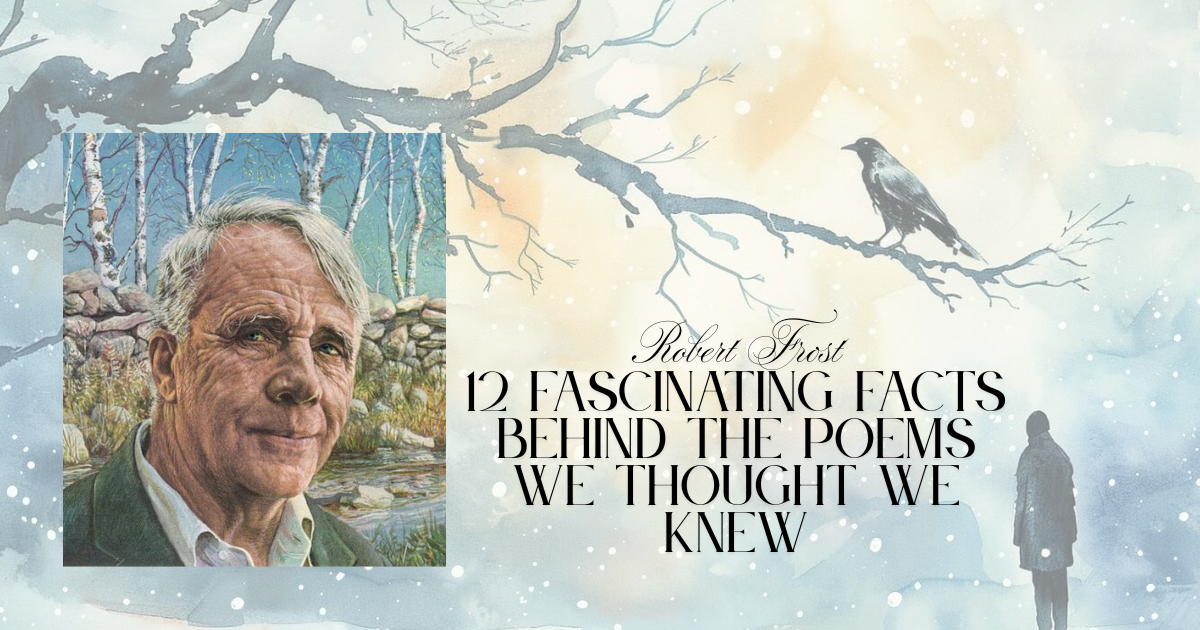 Robert Frost
For many readers, the name Robert Frost immediately brings to mind quiet snowy woods, country roads diverging in yellow forests, and memorable lines like ‘And miles to go before I sleep’. His poetry feels simple, almost conversational—something that makes it a staple of school textbooks and public recitations. Yet behind that apparent simplicity lies a life full of surprising turns, literary friendships, personal tragedy, and misunderstood ideas.
Frost’s poems are often quoted as inspirational wisdom, but the story behind the poet—and even behind the poems themselves—is far richer and more complex. Here are 12 fascinating facts that reveal how much there is still to discover about the poet we think we know.
Also read: From The Cat in the Hat to How the Grinch Stole Christmas!: 10 Things You Didn’t Know About Dr Seuss
1. ‘The Road Not Taken’ Was Actually a Joke

Few poems are quoted as often as ‘The Road Not Taken’. It is usually read as a triumphant celebration of individuality. But Frost himself found this interpretation amusing.
The poem was written partly as a playful jab at his close friend, Edward Thomas, who had a habit of regretting whichever path they didn’t choose during their countryside walks. Frost later called the poem ‘tricky’ because readers took it far more seriously than he intended.
Ironically, a poem meant as gentle satire became a global symbol of bold decision-making.
2. The Same Poem Played a Role in a Tragic Decision
 [Image Credit: England Remembered]
The story becomes even more poignant. When World War I began, Edward Thomas struggled over whether to enlist in the army. After reading ‘The Road Not Taken’, he reportedly believed Frost was teasing him about his indecision.
Eventually Thomas enlisted—and was killed in battle in 1917. Frost later said that Thomas was ‘the only brother I ever had’.
3. A Fantasy Epic Was Inspired by Frost

Frost’s influence stretches far beyond poetry. His short poem ‘Fire and Ice’ inspired the title and themes of A Song of Ice and Fire by George RR Martin.
Martin has acknowledged that Frost’s meditation on destruction—whether through passion or hatred—influenced the conceptual foundation of the series that later inspired the TV show Game of Thrones.
The poem’s stark vision of how the world might end has also traveled far beyond Frost’s time; its lines later appeared in The Twilight Saga, proving the lasting cultural reach of ‘Fire and Ice’.
4. ‘Mending Wall’ Was Based on a Real Wall

‘Good fences make good neighbors’ is one of Frost’s most famous lines, appearing in his poem ‘Mending Wall’.
What many readers don’t realise is that the poem was inspired by an actual stone wall near Frost’s farmhouse in Derry, New Hampshire. Frost and a neighbor would repair the wall together each spring, an experience that eventually became the backbone of the poem.
5. ‘Birches’ Came From a Childhood Game
 [Image Credit: www.gnssharma.blogspot.com]
The lyrical poem ‘Birches’ describes a boy swinging on bent birch trees in the countryside. The imagery feels dreamlike—but it came from Frost’s own childhood.
As a boy, he loved climbing birch trees until the trunk bent under his weight and then letting the tree spring upright again. The poem transforms this childhood pastime into a metaphor for escaping and returning to reality.
6. His Life Was Marked by Deep Personal Loss
 [Frost and his family. Image Credit: The Frost Place]
Despite the calm beauty of his nature poems, Frost’s life was filled with tragedy. His father died when Frost was eleven, leaving the family in financial hardship. Later, his mother died of cancer, and his sister spent years in a mental institution.
Of the six children Frost and his wife Elinor had, only two outlived him. Such losses contributed to the darker undertones often found beneath the pastoral surface of his poetry.
7. He Didn’t Graduate From College
 [Robert Frost as Lawrence High School Valedictorian, 1892. Image credit: The Frost Place]
It may surprise readers that one of America’s most celebrated poets never completed a college degree.
Frost briefly attended both Dartmouth College and Harvard University but left without graduating. Instead, he pursued writing, teaching, and farming before eventually finding literary success.
8. He Almost Gave Up on Poetry—Before A Boy’s Will Changed Everything
 [Robert Frost poses atop Mount Lafayette in Franconia, New Hampshire, with three of his children—Carol, Marjorie, and Lesley—alongside two unidentified companions. Image credit: The Frost Place]
By the time Frost turned nearly forty, he had published almost nothing. Frustrated by the lack of recognition in the United States, he made a bold decision: he sold his farm and moved his family to England in 1912.
The gamble paid off. In England, publishers were far more receptive, and Frost’s first poetry collection, A Boy’s Will, appeared in 1913.

9. A Famous Poet Helped Launch His Career
 [Ezra Pound. Image credit: Poetry Foundation]
In England, Frost met the influential poet and critic Ezra Pound.
Pound enthusiastically promoted Frost’s early work, helping introduce him to the literary world. Yet the relationship was complicated; Frost sometimes suspected Pound expected favours in return. Their friendship remained both supportive and tense.
10. One of His Darkest Poems Came From a Real Accident

Frost’s poem ‘Out, Out—’ tells the horrifying story of a boy who dies after a buzz-saw accident.
The poem was inspired by a real incident in which a neighbour’s child suffered a similar fate. The tragedy deeply affected Frost, and he transformed the event into one of the most haunting poems of modern literature.
11. He Read a Poem at a US Presidential Inauguration
 [Image Credit: National Council of Teachers of England]
In 1961, Frost became the first poet to read at a US presidential inauguration when he was invited by John F. Kennedy.
Bright sunlight prevented Frost from reading the new poem he had prepared, so he recited ‘The Gift Outright’ from memory instead—a moment that became one of the most memorable intersections of poetry and politics in American history.
12. His Poems Even Appeared in Moments of National Mourning

After the assassination of President John F. Kennedy in 1963, lines from Frost’s poem ‘Stopping by Woods on a Snowy Evening’ were quoted during the funeral coverage.
The poem’s closing line—’And miles to go before I sleep’—had become closely associated with Kennedy’s speeches and ideals, giving the words a poignant new meaning in the wake of his death.
The Poet Behind the Quiet Woods
Robert Frost’s poetry often feels calm and contemplative, full of snowy landscapes and country paths. But the stories behind those poems reveal a life far more complex—marked by humour, rivalry, grief, and surprising cultural influence.
Perhaps that is why Frost’s work endures. Beneath the simple language lies something universal: the tension between choice and regret, nature and humanity, hope and loss.
The roads in Frost’s poems may seem quiet, but behind them lies a lifetime of stories that continue to echo through literature—and through readers who keep discovering new meanings in lines they thought they already understood.
Your next read: Victor Hugo’s Very Loud Private Life: Exile, Mistresses, and His Naked Writing Rituals